A curator-led conversation with artist Kylie Stillman and virtual walk through of her exhibition ‘Not fully or properly either of two things’ Town Hall Gallery 2020.
'Art Guide Australia' Interview
Visit Art Guide Australia to read Sheridan Hart’s interview ‘Kylie Stillman delves into the secret life of books’
https://artguide.com.au/kylie-stillman-delves-into-the-secret-life-of-books

SMALL SCULPTURE AWARDS
I am delighted to be a finalist in the 2020 McClelland National Small Sculpture Awards. Congratulations to the 4 award recipients and other finalists. An online exhibition catalogue can be found at:
https://artcollector.net.au/mcclelland-announces-inaugural-small-sculpture-award/

Cypress Pine
Thank you Qatar Foundation for sharing this image of ‘Cypress Pine’

qf_arttrail Check out our story to learn about this amazing piece by @kylie.stillman
https://www.instagram.com/p/CB3tG58JO9R/?utm_source=ig_web_copy_link
Image: Kylie Stillman ‘Cypress Pine’ 2012
Collection of Qatar Foundation installed at Sidra Medicine, Doha
Isolate with Linden
The Linden New Art team is happy to share some great links and art activities with you during the closure of the gallery.
Kylie Stillman’s solo exhibition The Opposite of Wild was shown in 2017 at Domain House in Melbourne’s Royal Botanic Gardens, while our Acland Street home was being renovated. We asked Kylie what she had been working on recently and what had been keeping her entertained and motivated over the recent weeks.

“Isolation for me has had me yearning for everything audio. The need to be on screens to communicate for work and learning had me reach for Bluetooth headphones and speakers and flood the house and studio with music, audio readings and conversation. Here are my three loves that are getting me through:
Dan Fox has released a makeshift audio recording of his book ‘Limbo’; the work has been great to revisit in the current climate of isolation:
https://soundcloud.com/danfoxx/sets/dan-fox-limbo
Richard Watts, 9am - 12pm Thursday on RRR Smart Arts. To be able to still hear from the Melbourne arts community has helped bring the wider world within virtual reach:
https://www.rrr.org.au/explore/programs/smartarts
And for the kids (3-6 years old), I have discovered Kinderling, which plays quality kids radio programs and music all day long.
https://www.kinderling.com.au/
Unfolding Time

Exhibition image: Kylie Stillman ‘Japanese White Pine’ 2005 hand cut books
Thank you Penelope Seidler AM for sharing this install shot of my work ‘Japanese White Pine’ which is now part of the collection of Maitland Regional Art Gallery and on exhibition until 16 February 2020 in ‘Unfolding Time - Penelope Siedler’s Gift to Maitland’
This exhibition reveals the stories told by the artists whose works Penelope Seidler has donated to the Gallery Collection and coincides with the ten year anniversary of the opening of the new redeveloped Maitland Regional Art Gallery.
A Stitch in Time

Coming soon: A Stitch in Time
30 November - 16 February 2020
Hamilton Gallery, Victoria Australia
Artists: Fiona Abicare, Vicki Couzens, Marion Manifold, Sanné Mestrom, Sally Smart, Kylie Stillman, Louise Weaver
Curated by Maudie Palmer AO and Eugene Howard
A Stitch in Time brings together the work of seven prominent, contemporary Australian artists, each working across a broad range of media from painting, sculpture and printmaking, to design and installation. These artists are unified by a shared interest in working with an array of traditionally craft-related techniques. Predominantly classified as an ‘inferior art’ in Western history, the elevation of craft as a ‘high art’ and the recognition of women artists has been inextricably linked. Today, craft practices sit resolutely within contemporary art, imbued with consequential cultural and political power. A Stitch in Time presents artists who skilfully enfold a myriad of techniques and processes into works of profound potency.
The Venation
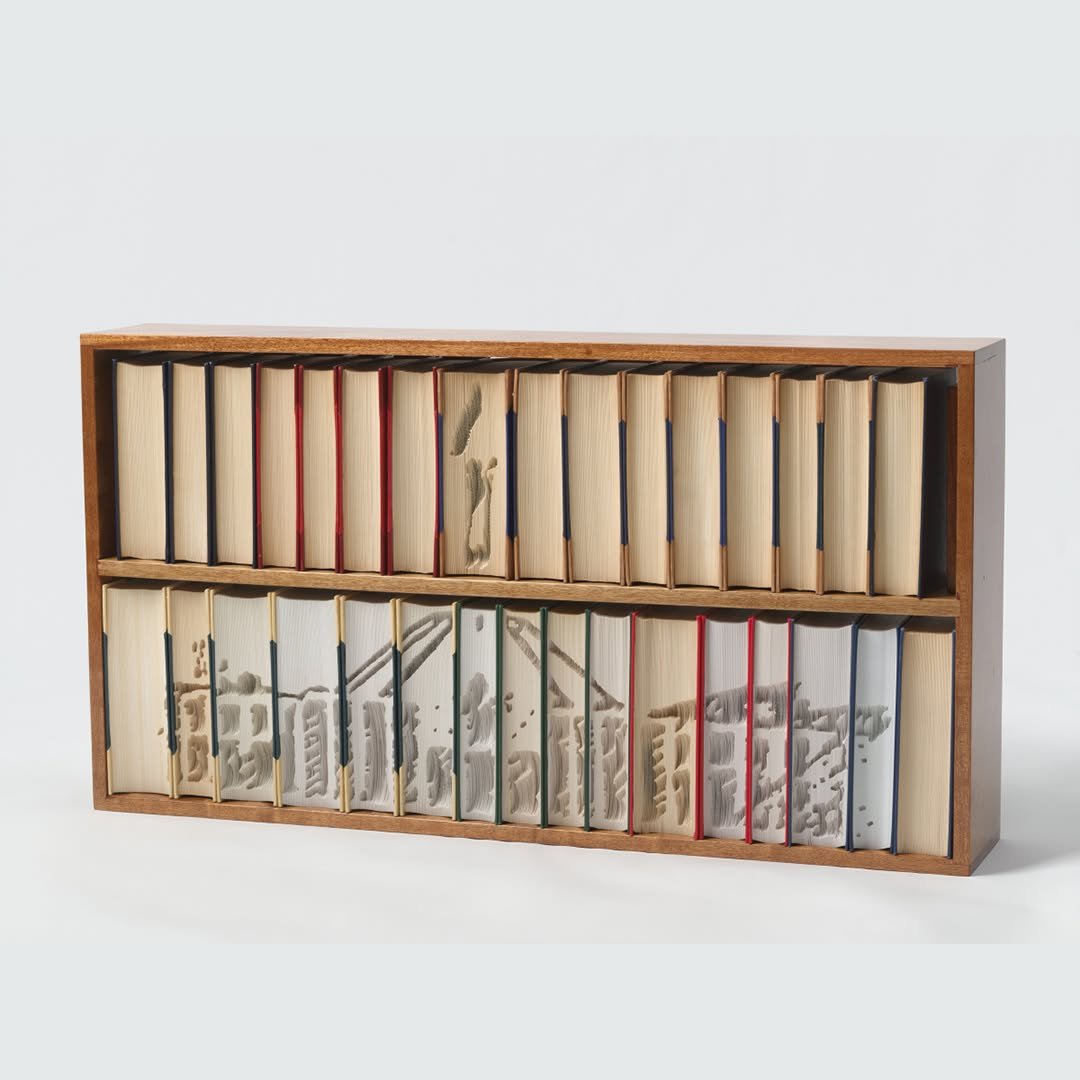
‘The Venation’ now in the best of care in the Collection of State Libraray of Victoria. It will be on display in the library's ‘World of the Book’ exhibition from mid-November 2019.

Kylie Stillman ‘The Venation’ 2014, hand-cut paperback books

'Remember the Wild' interview
Shadow, scale and industrial waste in Kylie Stillman’s ‘Eucalypt’
Rachel Fetherston
The sculptures of Melbourne artist Kylie Stillman are a prime example of the way that art makes us question how we as individuals and as a species influence the world around us. Kylie’s pieces do not simply stand alone as human-made objects – rather, a sculpture may appear to alter the very atmosphere it resides in. It’s a feeling that changes depending on where you are standing to view the piece – surely a mark of truly engaging art. Notably, Kylie’s artworks challenge the relationship between natural and artificial materials and the way we humans both use and connect with nature. Now that we’re close to celebrating National Eucalypt Day, these thoughts are of particular importance.
Kylie is the inaugural recipient of the Eucalypt Commission for an outdoor sculpture currently installed outside the Castlemaine Art Museum as part of the Castlemaine State Festival. Remember The Wild spoke with Kylie about her past work, her ‘Eucalypt’ sculpture and the nature-based inspiration behind her art – in particular, the mighty eucalypt.
On your website, you state that both birds and plant life often find a place in your artwork. Why do you think this is?
In 2017 I had an exhibition titled ‘Opposite of Wild’ where I asked myself this very question, analysing the relationship I have with birds and plant life. To me the opposite of wild is to be calculated, something that artists and nature have in common. They both have a reputation for being wild, free and spontaneous, but they are (mostly!) calculated, planned and strategic workers – they have to be or they would not survive.
In that vein, the decisions I make in creating works are quite calculated whilst giving an impression of simplicity and immediacy, just like the imagery I represent: branches, leaf skeletons and birds in flight – formal arrangements that aid survival, quite the opposite of wild and quite calculated, and this relates to how I make things and how I enjoy thinking and planning.
In your work titled ‘Eucalypt Series’, you integrate objects such as books and reams of paper with carvings of eucalypt branches. What does this artwork represent?
I studied painting at RMIT and primarily produced works from found materials using domestic tools and methods, I struggled to be inspired by paint found in a tube and was more interested in finding materials and pigments from the ‘constructed world’ to create an artwork. I see these stacks of books and reams of paper as an extension of this way of working, I carve into objects and create shadow and tone as opposed to using a paintbrush or palette knife.
Primarily the works come to represent absence; in the ‘Eucalypt Series’ we see a collection of branches – in fact they are not branches at all, instead it is their absent form, and this absent form is not just a branch but a record of the movement of the sun; how each twist along the structure is a record of the direction of light and nutrient. Again, quite the opposite of wild and quite calculated.
This is a conundrum too, as the representation of trees is created by the removal of trees through paper manufacturing. This absence of the trees is not accidental, it is a lyrical prompt for the viewer to reconsider the origins of the materials we use and dispose of daily.
Explain the outdoor sculpture that you’ve created for the Castlemaine State Festival. What inspired you to create it and in what way does it celebrate the eucalypt?
The Eucalypt Commission ‘Eucalypt’ 2019 is a stack of recycled plastic HDPE sheeting that form on one side a solid and impenetrable wall and on the other side reveal the negative form of an iconic eucalypt silhouette. The form that is removed from the material, and the resultant shadow lines and revealed textures, create the pretence of a tree that is in fact not there at all.
‘Eucalypt’ is a chance for people to consider the importance of the natural world. The intention is to create an experience, an artwork that represents a recognisable tree form but presents it in an arresting way as the viewer is confronted with an absence – a void, not empty but filled with light and shadow creating an illusion of form. The dimensions of the work mirror the standard sizes of our constructed world. Building materials are commonly available in sizes of 2400 mm and 1200 mm; these sizes become regular occurrences in our built world environment, determining the heights of walls, sizes of rooms and doorways.
This notion of human scale, generous and accommodating when used internally (within the home), become surprisingly dwarfed when competing with nature’s own constraints and the awe-inspiring experience of being amongst trees, whose size is based on survival aids determined by the availability of light, water and the stretch of their root systems. In response to these concerns of scale ‘Eucalypt’ is presented on this site to draw contrast and reverence to the natural world and its proximity to ‘town’ life. The scaled-down eucalypt here reads as an ornamental folly alongside the monolithic specimens of eucalypt found in the area.
The materials selected too, whilst not wood as it may be read from a distance due to its light timber colouring and ‘plank-like’ building site formalism, have additional significance to the work and the role timber and plastics play in our daily lives. The environmental impact of the source material contributes to the reading of the work: created from recycled material, this plastic sheeting is produced from post-industrial waste. According to the plastics manufacturer, every 50 kilograms of this material represents the equivalent of 12,500 plastic packages that would have created 0.17 cubic metres of landfill.
What do you hope the public will take away from experiencing this sculpture?
My hope is that the viewer feels rewarded by the experience of standing in close proximity to the sculpture. That they can get up close and see the individual cuts that go into making the work and see the effect these cuts have on how daylight falls on the work.
Based on the inclusion of various natural elements in your work, would you call yourself an environmental artist?
I have not actively intended to create environmental art, I make the work that interests me using materials I find have integrity to the kinds of works I want to make. What I enjoy about art is how it has the ability to be different things to different people and I enjoy that my work addresses issues relating to the natural and urban environment.
When working on your sculptures, does your process involve any kind of immersion in the natural world? If so, can you describe this immersion?
I don’t seek out immersion in the natural world to any great extreme, I find it important to form observations for my artworks in everyday experiences with nature from urban to suburban environments. Walking in the natural world is my primary way of engaging with nature and not just a means of finding inspiration but of importance to me in maintaining physical and mental health.
Finally, do you have a favourite species of eucalypt?
I have a soft spot for River Red Gums that keep me company on my daily walk – they have served as muse for my artworks for many years.
Banner image: Kylie Stillman, ‘Eucalypt’ 2019, hand-cut recycled HDPE sheeting and steel 240 x 240 x 30 cm. Commissioned and created with the assistance of Eucalypt Australia, La Trobe Art Institute and Castlemaine State Festival. Photograph courtesy of the artist and Utopia Art Sydney.
About author
Rachel Fetherston is currently a PhD candidate at Deakin University investigating the impact of Australian ecofiction on readers' environmental attitudes and behaviours. She is also a freelance writer and the publications manager at Remember The Wild.
Originally published, 21 March 2019:
http://www.rememberthewild.org.au/shadow-scale-and-industrial-waste-in-kylie-stillmans-eucalypt/?fbclid=IwAR25EZX8o-MFSf-7fUWmml_Jk7ZL62lpuP9G3N8F6HBFvS6p4cmitNTodG4
Castlemaine State Festival Launch
First view of ‘Eucaypt Commission’ and preview of Castlemaine State Festival Visual Arts Program Saturday 16 March, 4pm at Castlemaine Art Musuem. Full program opens 22 March curated by Latrobe Art Institute so many artists so excited to be involved. castlemainefestival.com.au

Kylie Stillman 'Eucalypt' 2019 (left) Castlemaine Art Museum
Commissioned and created with assistance of Eucalypt Australia, La Trobe Art Institute and Castlemaine State Festival
Photo: Courtesy of the artist and Utopia Art Sydney
Montalto Sculpture Prize

Kylie Stillman ‘Moonah’ 2019
On Sunday 24th February 2019, the Mitchell family were joined by fellow judging panelists, artists and guests on a picture-perfect Red Hill day for the announcement of the 2019 Montalto Sculpture Prize: ‘Moonah' by Kylie Stillman.
Moonah is a free-standing stack of hand-cut fence paling panels, an imposing work that continues Kylie’s use of working with everyday materials and follows her use of books and papers, to form the objects into which she carves. These often enigmatic ‘blocks' have a presence in themselves, and in this case, the stack of panels form on one side a solid and impenetrable wall and on the other side reveal the negative form of a coastal moonah tree, a dramatic ‘tortured wind-formed’ silhouette familiar to the area.
In a style familiar to her practice, the form is removed from the block, and it is the resultant shadow lines and revealed textures that create the pretence of a tree, that is in fact, not there at all. This absence of the tree and the scale of the block of material is not accidental, it is a lyrical prompt for the viewer to reconsider the origins of the matter we use to assemble our constructed world.
This year’s judges included John Mitchell (owner of Montalto), Peter Williams (architect behind Montalto’s iconic buildings, Williams Boag Architects), Phillip Doggett-Williams (artist and educator), Kelly Gelatly (Director of the Ian Potter Museum at the University of Melbourne) and Lisa Byrne (Director of McClelland Sculpture Park) who deliberated over a record number of entries from some spectacular Australian artists.
'Moonah' will join the previous prize winners as part of the Montalto permanent collection with the other 29 shortlisted sculptures staying on exhibition at Montalto for the next 6 months. While in situ, guests visiting Montalto can nominate their favourite sculpture for the People' Choice Award.
For more information about sculpture at Montalto website: https://montalto.com.au/sculpture
The Eucalypt Commission
Castlemaine State Festival has announced a new partnership between philanthropic, educational and creative industries. Eucalypt Australia, La Trobe Art Institute and Castlemaine State Festival have worked together to create the Eucalypt Commission.

Image: Kylie Stillman 'Eucalypt Series' 2012 - 2016 Hand-cut paperback books
The Eucalypt Commission allows an artist to produce a new work that will be exhibited at the Castlemaine State Festival in March 2019. Eucalypt Australia is partnering with the Castlemaine State Festival to celebrate and promote the significance of the eucalypt. The Commission provides for the production of new artistic work that communicates the ecological, cultural and economic value of this most iconic Australian tree. The Castlemaine State Festival is pleased to partner with Eucalypt Australia in ways that serve mutually beneficial ends and this partnership is a perfect way to ensure the development of quality art for the Festival.
The Eucalypt Commission has been awarded to Kylie Stillman for an outdoor sculpture that symbolises the beauty of the eucalypt and the importance of 'light' to its very existence. In a nuanced balance of representation and abstraction, Stillman has proposed an evocative piece that also take into account the context of its setting, at the entrance forecourts of the Castlemaine Art Museum. The artist is highly regarded, with her work being regularly exhibited across commercial and public institutions. Layering materials and often cutting away to create forms in the void of absence, Stillman’s work reveals a skill of craft and a conceptual edge.
The Commission was an open call out and received a significant volume of entries from across the country. The judging panel consisted of key industry people, including the Director of Shepparton Art Museum Dr Rebecca Coates and Associate Professor Jacqueline Millner from La Trobe University. The Eucalypt Commission artwork will be presented as part of the visual arts program at the Castlemaine State Festival and will form part of a hub of activity and interest centred around the Castlemaine Art Museum.
Trace at Bunjil Place
Opening this week ‘Trace’ at Bunjil Place Gallery
24 November 2018 to 24 February 2019

Kylie Stillman 'Masking the Seam' 2017
Hand-cut paperback books, timber, saw horse, ladder
182 x 144 x 80 cm
Artists: Joyce Hinterding, Laith McGregor, Cameron Robbins, Sandra Selig, Kylie Stillman, Gosia Wlodarczak
Looking beyond the traditional definitions of drawing, this exhibition acknowledges the work of six contemporary Australian artists who utilise principles of drawing whilst expanding upon what the definition of drawing can be.
Recognising the unexpected and illuminating ways these artists have shaped the medium, Trace features 40 new and recent works. These include pencil and ink drawings by artist and machine, hand sewn drawings on paper, a mesmerizing thread installation that spans across space and walls through to intricately carved books, and sound producing induction drawings.
‘I like presenting ideas that show how marks on a page can show both the immediacy in expressing an idea and also be a complex planned drawing that is laborious and time consuming. Many of my works also explore ways of showing three-dimensional forms on a two dimensional plane. This interest is directly connected to my background in domestic craft and having learnt to sew and construct garments from a young age, laying out fabric flat and working with a pattern to construct something that forms to the contours of the body.’
Kylie Stillman


Sydney Contemporary 2018
Big thanks to Sydney Contemporary for including my large scale work ‘Scape’ in ‘Installation Contemporary’ program at this year’s Fair.
Curated by Nina Miall, Installation Contemporary presents Australian and international artists, whose innovative and often site-specific installations range from the handcrafted to the digital. The program includes Kylie Stillman's Scape, a free-standing stack of over 200 hand-cut plywood panels.
Sydney Contemporary 13 - 16 September 2018, Carriageworks: 245 Wilson Street, Eveleigh

Facade
Parliament House Canberra
16 August – 21 October 2018
Curated for the 30th anniversary of Australian Parliament House (APH) this exhibition features artworks inspired by the architecture of APH and in particular the ‘façade’ of the building. Over the past 30 years the façade of APH has become a recognizable symbol of democracy and government throughout Australia and it has been appropriated and celebrated by many contemporary artists.
Kylie Stillman 'Parliament House afternoon shadow' 2018
Hand-cut books and timber 110 x 55 x 20 cm
Podcast - Art as defiance
Mornington Peninsula Regional Gallery Podcast
Kylie Stillman - art as defiance.
Kylie talks to curator Danny Lacy about the defiance of creativity, the genesis of her book carvings and the idea behind her National Works on Paper piece 'Just C'.

Staying Power
Curated by Penelope Davis 'Staying Power' is an exhibition showcasing selected works from established women artists.
Artists include: A.A, Megan Evans, Kate Just, Chaco Kato, Jennifer Mills, Allison Rose, Kylie Stillman.
Relatively Famous
Roger Averill's 'Relatively Famous' published by Transit Lounge

Cover artwork: Kylie Stillman 'White-throated Needletail' 2005 book carving
Fairy Tales Transformed
The forest is a key trope within the fairy tale lexicon and is symbolic of both possibility and adventure, but also death and a sense of foreboding.
All the better to see you with: Fairy tales transformed curator Samantha Comte talks about how Kylie Stillman, Tracey Moffatt and Polixeni Papapetrou represent the forest in their work and the important role it plays within the fairy tale cannon.

For the full length video, see Ian Potter Museum of Art Facebook page https://www.facebook.com/ian.potter.museum.of.art/videos/10155110267931594/
Image: Installation view of Kylie Stillman's 'Scape' 2017 courtesy of the artist and Utopia Art Sydney
Adelaide Perry Prize
Delighted to be exhibiting alongside these artists in the Adelaide Perry Prize for Drawing:
Tim Allen, Tony Ameneiro, Andrew Antoniou, Carol Archer, Stephen Bird, John Bokor, Nicola Bolton, Chris Bond, Damian Broomhead, Tom Carment, Michelle Cawthorn, Serena Christie, Adam Cusack, Dagmar Cyrulla, Amy Dynan, Helen Eager, Robert Ewing, David Fairbairn, Garry Foye, Todd, Jane Grealy, Nicci Haynes, Paul Heppell, Kendal Heyes, Eamonn Jackson, Melody Jones, Krystyna Katsouri, Jennifer Keeler-Milne, Matthew Kentmann, Martin King, Ceara Metlikovec, Damian Moss, Catherine O'Donnell, Becc Ország, Claire Primrose, Evan Salmon, Andrew Seward, Peter Sharp, Mike Staniford, Kylie Stillman, Craig Waddell, Anna Warren, Stuart Watters and Peter Wegner.
The Adelaide Perry Prize for Drawing
3 to 29 March.
Adelaide Perry Gallery
Corner Hennessy and College Streets Croydon Sydney NSW
